

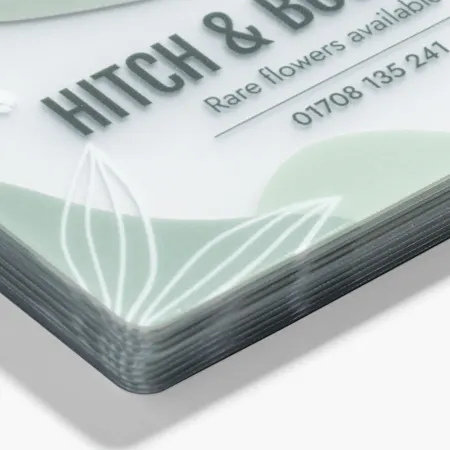
A business card does its real work after it leaves your hand. From that moment, it sits in a wallet, a pocket, or a desk drawer, quietly representing your brand long after the conversation ends. The problem is that most paper cards start to look tired within weeks, and a worn card conveys a weaker message than a fresh one.
That short shelf life is exactly why a growing number of businesses now choose to print plastic business cards instead. A plastic card outlasts paper in two ways, since it survives physical wear and also stays in circulation far longer. In almost every real situation, plastic holds up better than paper.
Plastic vs. Paper Business Cards
Plastic business cards are built from PVC and stand up to daily handling, while paper cards weaken with every bend, spill, and trip through a pocket. A standard paper card may look sharp on day one, yet it often shows creases and soft corners within a few weeks of normal use. A plastic card keeps its shape and finish for years, which means your contact details stay readable and your brand keeps looking professional. Since the card stands in for your business, that longer lifespan turns into more positive impressions over time.
How Plastic Cards Strengthen First Impressions
A durable plastic card does not just survive, since it also signals quality every time it changes hands. The weight and finish of plastic say something about the brand before anyone reads a single word.
First impressions are physical as much as visual. When someone takes a firm, smooth plastic card, they often pause, turn it over, and remember the moment, and that small reaction can set the tone for everything that follows. A flimsy card slips out of memory quickly, while a card that feels substantial earns a few extra seconds of attention at exactly the right time.
Because the card lasts, that impression repeats. Every time someone pulls out a clean, sturdy card weeks or months later, your brand looks just as polished as the day you handed it over.
Why Are Plastic Business Cards More Durable?
Plastic business cards are made to resist the everyday stresses that quickly wear paper down. Their strength starts with the material itself and carries through to how they are built and made.
PVC Holds Up Better Than Paper Cardstock
PVC plastic comes from the same family of materials used for credit cards and ID cards, which tells you a lot about how it performs. It does not absorb moisture, it resists tearing, and it springs back to shape instead of holding a crease.
Paper cardstock, even at a heavy weight, simply cannot match that. It depends on coatings and thickness for protection, while plastic gets its durability from the material itself, so the card stays intact through years of regular use.
Thickness and Rigidity That Resist Wear
Most plastic business cards are made at a credit-card-grade thickness of around 0.76mm, also known as 30pt. That rigidity gives the card several advantages:
- It resists bending and stays flat inside a wallet
- It feels substantial and high-quality in the hand
- It protects printed details and codes from damage
That mix of strength and feel is a big part of why plastic cards keep performing long after a paper card would have given out.
Quality PVC Manufacturing Improves Durability
The finished durability of a card also depends on how it is made and what it is made from. Premium-grade PVC, clean printing, and proper finishing all decide whether a card lasts for years or starts peeling and fading early.
This is where manufacturer quality matters. Companies such as Duracard print on premium, USA-made PVC and finish each card to hold up against daily wear, which is the difference between a card that survives real-world use and one that does not.
Water Resistance of Plastic Business Cards
One of the clearest advantages of plastic is how well it handles moisture. Where paper warps and stains, plastic shrugs off water and keeps its finish.
This matters most for people who work in busy, hands-on, or outdoor settings, where cards are exposed to the elements. Plastic is a strong fit for industries such as:
- Construction, trades, and home services
- Gyms, salons, and med spas
- Restaurants, bars, and hospitality
- Automotive shops and car washes
- Event vendors and outdoor businesses
For anyone whose card is likely to meet water, sweat, or humidity, plastic removes a weakness that paper can never fully overcome.
Long-Term Value of Durable Plastic Business Cards
Price per card is the wrong way to measure value, since a cheap card that gets thrown away does nothing for your brand. The better measure is how much use you get from every card you hand out.
It helps to think in terms of cost per impression rather than cost per card:
- Longer Shelf Life: A plastic card can stay in a wallet for years, earning impressions long after a paper card would have been thrown away.
- Fewer Reprints: Because the card does not wear out quickly, you reorder less often, which offsets the higher upfront price over time.
- Stronger Recall: A card people keep and reuse keeps your brand in front of them, which is the entire point of handing one out.
When you weigh those benefits together, the decision to print plastic business cards looks less like an added cost and more like a smart investment.
Who Should Use Plastic Business Cards?
Plastic cards pay off most for people whose work depends on strong, lasting impressions. If your card is part of how you win business, durability is worth the upgrade.
The professionals and industries that benefit most include:
- Real estate agents and brokers
- Contractors and skilled trades
- Hospitality, salons, and med spas
- Loyalty, membership, and rewards programs
- Sales teams and consultants
- Event planners and trade show exhibitors
If your work falls into any of these areas, it makes sense to print plastic business cards that match the quality of the service you offer.
FAQs
How long do plastic business cards last compared to paper?
Plastic business cards can stay in good condition for several years, while paper cards often start bending, fading, or fraying within weeks. The PVC material resists the daily wear that quickly ages a traditional paper card.
Are plastic business cards waterproof?
Plastic business cards are highly water-resistant because PVC does not absorb moisture the way paper does. They survive spills, rain, and humidity without warping or staining, which makes them a reliable choice for hands-on and outdoor work.
How thick are plastic business cards?
Most plastic business cards are made at around 0.76mm, also called 30pt, which matches the thickness of a standard credit card. That rigidity helps the card stay flat, feel premium, and resist bending in a wallet.
Do plastic business cards cost more than paper?
Plastic business cards usually cost more upfront than basic paper cards, yet they compete closely with premium paper. Their longer lifespan and fewer reprints often make them better value over time for brands that want a lasting card.
Can plastic business cards include QR codes or NFC?
Yes, plastic business cards work well with both QR codes and NFC chips. The rigid, smooth surface keeps codes scannable and protects the chip, so the digital features keep working reliably for as long as the card lasts.
Conclusion
Paper business cards fade, bend, and end up discarded, while plastic keeps its shape, resists water, and stays in circulation for years, which is what truly sets the two apart. A plastic card lasts longer in the wallet and longer in memory, so it keeps earning impressions and protecting your brand long after a paper card would have been forgotten. If you want a card that keeps working for your organization, the smarter move is to print plastic business cards.
Duracard helps businesses make that upgrade without the wait. As a USA-based manufacturer, it prints durable, premium PVC business cards with a fast five-day turnaround, rush options when deadlines are tight, and a free online design tool that makes building a standout card simple.
The team at Duracard turns a first impression into a lasting one for anyone ready to trade cards that fade for cards that get remembered. Explore their options and create a card built to outlast the rest.
